December 2025 Updates
December Calendar
Each Wednesday in December: Permanent Ceasefire Vigil - corner of Foothill and Indian Hill -- 4 pm.
Every Friday: Peace Vigil - corner of Arrow Highway and Indian Hill - 3:30 to 4:30 pm, and at Pilgrim Place at the Octagonal Garden from 4 - 4:30 pm.
Tuesday, December 2, 3 pm -- SSAFE Chapter Meeting, Napier Common Room. (SSAFE stands for Senior Stewards for the Environment.)
Wednesday, December 10, 10:30 am -- Current Affairs Forum in Decker, "A Psychological Anthropology of the US Political Context." Presented by Claudia Strauss, Pitzer College.
Thursday, December 11, 10:30 am -- Justice Groups Meeting, Napier Common Room.
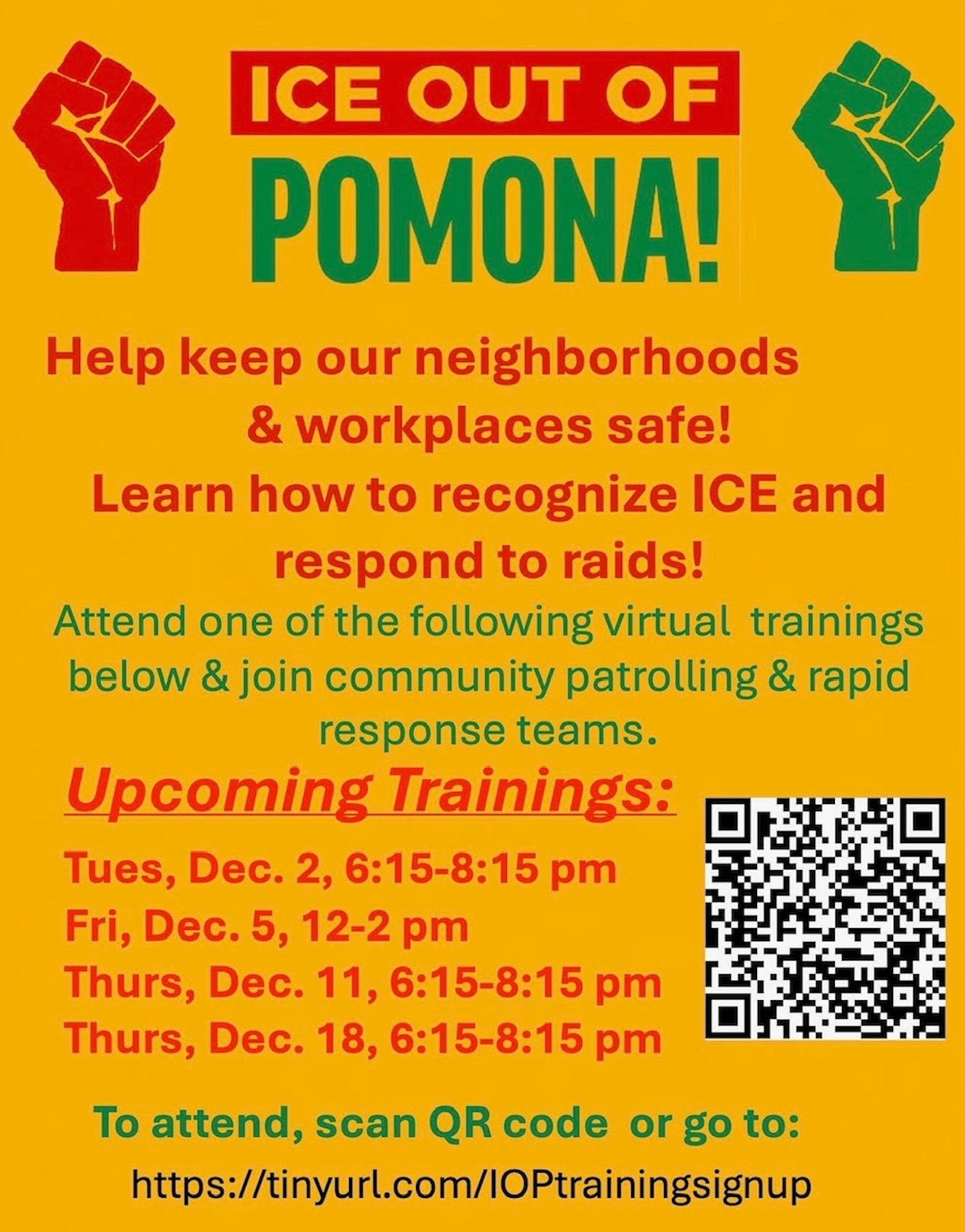
Now through December 31 -- Join Pomona's dA Center for the Arts in supporting the Arts and Hearts Benefit for the City of Pomona's Compassion Fund. Artists, musicians, poets, actors, art lovers, and community members are encouraged to participate and contribute to this worthy cause for those in critical need due to the actions and continuing presence of ICE in Pomona. Lots more details (including specific event dates with ticket information) are available here.
Stories You May Have Missed
From CalMatters (Submitted by Sid M.)
ANNUAL SOCAL COMMUNITY SURVEY ON HOUSING
The Southern California Association of Governments (SCAG) published their annual community survey in October, bringing a snapshot of housing and commuting across San Bernardino, Riverside, Orange County, Los Angeles and Imperial Counties. The report’s conclusions: we need more childcare, more family-friendly workplace policies and more housing.
Seventy percent of children live in a household where both parents work, requiring these families to pay for childcare. The construction of new housing has not continued to match demand, said Kevin Kane, SCAG program manager for demographics and housing policy. He pointed to the region’s overcrowding rates, a figure he says is representative of supply not meeting demand, and of people jamming into homes to save on rent.
Overcrowding is defined as more than one person per room in a household. Nine percent of homes are considered overcrowded in San Bernardino County, compared to 8% in Riverside, 10.5% in Los Angeles County, 10% across the SCAG region, 7% in California, and only 3.5% across the country.
Despite overcrowding, the percentage of households that spend more than 30% of their income on housing costs has slightly declined since 2006. This mirrors a national trend, according to the report. Forty-one percent of households in Riverside and San Bernardino Counties, 43% across the entire SCAG region, and 32% across the nation spend more than 30% of their income on rent. In 2006, the number was closer to 47% in the SCAG region.
The report shows that work-from-home has stabilized, with 10.3% of workers in San Bernardino, 11.5% in Riverside, and 14% from the entire SCAG region working from home in 2024. That is a jump from before COVID: in 2019, only 6% of employees worked from home. Only 2.7% of workers took transit in 2024, a decrease from 3.8% in 2019, and from 4.9% in 2006, when SCAG began collecting the information.
Home ownership rates have not changed much in recent years. Riverside County has the highest home ownership rate in the SCAG region, with 68% of home ownership compared to 63% in San Bernardino County, 46% in Los Angeles County, 53% across SCAG and 65% across the entire nation.
College education rates are also rising, both locally and nationally. Twenty-four percent of people over 25-years-old in San Bernardino have a bachelor’s degree, compared to 26% in Riverside, 35% in the SCAG region, 40% across California and 39% across the country. In 2006, those numbers were 17% in San Bernardino, 19% in Riverside, 27% in the SCAG region, 31% across California and 27% across the country.
SCAG, a metropolitan planning organization, is governed by representatives of cities throughout the counties. Its goal with the data is to provide for informed policy decisions in response to the commuting, education and housing needs of the region. “Freeways don’t end at county borders. Labor markets don’t end at county borders. Your housing search radius doesn’t end at a county border,” said Kane.
The full 23-page report is available here.
From Church World Service, State of Play: Immigration Policy (Submitted by Sid M.)
In the days following the November 26 shooting of two members of the National Guard in Washington, D.C. by an Afghan asylee, the Trump administration immediately pursued a campaign of collective punishment: Announcing and implementing a sweeping immigration crackdown with massive implications for Afghans, refugees, asylum seekers, and immigrants both abroad and here in the U.S.
See below for a breakdown of all the statements and policy changes – and what we know so far about if and how they are already being implemented.
But first, we must make clear in this moment that CWS stands unequivocally with the Afghan allies, refugees, and newcomers who are building new lives in safety in the U.S. – and who are now facing new threats and hateful rhetoric. See CWS’ statement on Friday condemning both last week’s senseless violence and the response from Trump and his administration. CWS President and CEO Rick Santos said, “We must not let this tragedy beget more tragedy. We must not let it sow hate and division. And we must not let the newcomers who make our country strong be painted with the same brush as the one used for the perpetrator of this attack. Instead, let us heed our better angels.”
Alright, let’s try to break down what’s happening to our community. In the aftermath of the Wednesday shooting, the Trump administration responded by:
Halting all issuance of visas and “immigration-related requests” for Afghan nationals (Source: State Department Memo and USCIS Tweet)
What is it: The State Department and USCIS have halted all processing of visas for Afghan nationals overseas and for immigration benefit requests and adjustments of status for Afghans in the U.S. The visa halt includes Special Immigrant Visas (SIVs) for those who remain at risk on account of their direct support for the U.S. mission as well as other visa categories that were previously exempt from the ongoing June 4 travel ban. It also includes attempting to invalidate visas and boarding foils that were already granted for individuals who have not yet entered the U.S. The halt on processing benefits and adjustments, which comes in addition to the recent halt on green card processing for refugees, has not been fully defined by USCIS and its scope or potential exceptions remain unclear at this time.
Is it already in effect? Yes. Both the State Department and USCIS have described the halt as going into effect “immediately.” There are already community reports of individuals already granted SIVs removed from flights and of Afghan naturalization ceremonies being cancelled. However, it remains unclear at this time if those events were the direct result of the change in policy.
Reviewing all green card holders from the 19 countries on the travel ban list (Source: Press Secretary Tweet, USCIS Tweet, and CNN Report)
What is it: The administration intends to “reexamine” all green cards issued to those from the 19 countries “of concern” that are on the June 4 travel ban list. The countries of origin implicated in this retrospective review include Afghanistan, Burundi, Chad, Cuba, Republic of the Congo, Equatorial Guinea, Eritrea, Haiti, Iran, Laos, Libya, Myanmar, Sierra Leone, Somalia, Sudan, Togo, Turkmenistan, Venezuela, and Yemen. This re-examination comes in addition to the previously announced policy to review all refugees who entered the country from January 20, 2021 to February 20, 2025 (including green card holders). As was previously reported, USCIS has also now moved forward with new guidance around additional scrutiny in all “discretionary benefits requests” for individuals from the 19 countries.
Is it already in effect? There is no operational guidance from USCIS yet about how reviews, reexaminations, or re-interviews will actually take place, who will conduct the reviews, and what authority might be used to potentially revoke green cards. The memo on review of all refugees provides a three month window for when that guidance can be developed.
Halting all affirmative asylum application decisions (Source: USCIS Tweet, CBS News Report on guidance provided to asylum officers)
What is it: All affirmative asylum decisions by USCIS asylum officers have been indefinitely paused. Asylum officers have been told not to approve, deny, or close any pending asylum applications (of which over one million remain pending). This does not appear to apply to defensive asylum applications made in immigration court.
Is it already in effect? Per the CBS article linked above, guidance has already gone out to asylum officers implementing the asylum pause. No official guidance or policy statement has been made at this time regarding the review of those who have received asylum under the Biden administration.
Issuing statements regarding an intention to “permanently pause migration” from “third world countries” (Source: President Trump Thanksgiving Statement, NBC News Report)
What is it: In a social media post on Thanksgiving, President Trump vowed to “permanently pause” all migration from what he described as “third world countries.” The administration has also said that it will start a review of all asylum approvals under the Biden administration.
Is it already in effect? No. There has been no further details or policy guidance regarding the pledge at the time of publishing.
A torrent of hateful, divisive, and racist rhetoric. There has been rampant, xenophobic rhetoric from President Trump and several senior members of his administration that we must call out. In the days after the National Guard shooting, Trump stated that “only reverse migration can fully cure this situation,” and that “the refugee burden is the leading cause of social dysfunction in America.” Deputy Chief of Staff Stephen Miller said that “the only process invaders are due is deportation.” The Department of Homeland Security posted “remigration now” on social media, echoing a European far-right concept of ethnic cleansing and mass deportation. There have been several statements castigating the vetting undergone by Afghan allies and refugees.
By every metric, refugees and immigrants enrich and benefit American communities and make our country stronger. Those entering via humanitarian pathways to the U.S. like the refugee, SIV, and OAW processes have also all gone through extremely extensive vetting and screening processes and are among the most well-vetted travelers in the entire world. The shooter in Wednesday’s attack had been vetted thoroughly before working for the CIA in Afghanistan, was screened multiple distinct times during the Operation Allies Welcome vetting process, and went through continuous vetting after arriving in the U.S. – including through successful SIV and asylum proceedings. This was not a vetting failure, but a mental health crisis.
Temporary Protected Status
The Trump administration is limiting TPS and ending protections for many countries. Current updates:
Syria: a court order stopped it from ending on November 21, 2025, while it is further reviewed in the courts
Burma (Myanmar): set to end on November 25, 2025, but is accepting applications until then
Ethiopia: set to end on December 12, 2025, but is accepting applications until then
South Sudan: officially ends on January 5, 2026
Honduras, Nepal, Nicaragua: a judge stated it was unlawful to end their TPS, but how this will affect things is still to be determined
Note: TPS Burma and Ethiopia have not received their official termination notices yet. After that notice, people usually have 60 more days before their TPS and work permit ends.
Ukrainian deportations
The U.S. has increased the number of Ukrainians being deported who have final orders of removal. This mostly affects people who have lived in the country for many years and does not include people who currently have parole. On Thursday, the United Nations said of Ukraine that “no part of the country should be considered safe.”
An Inspiration for Activism
From EarthJustice (Submitted by Sid M.)
When Tania Galloni (with EarthJustice) heard about the cruel immigrant detention center being built in the Florida Everglades, she did not hesitate. “It was just so fundamentally wrong. Wanting to detain thousands of people in the heart of the Everglades, setting up these makeshift structures. The impetus was just – OK, what do we need to do? Because we're doing it.”
Galloni and a team of environmental lawyers challenged the Everglades detention center in court. They won a crucial early victory when the judge sided with them, ordering the center to wind down operations while the case played out. Yet when the state of Florida appealed, an appellate court paused the order.
Reporters have asked Galloni: was it worth it? Why fight if you aren’t sure of victory? To Galloni, the answer is obvious. “Anytime we don't show up for a fight, it's a loss,” she says. “We won't always win, but showing up is the only way you can win. The only way you lose is if you don't fight – and then, you're ceding ground. If we don’t fight, then we’re allowing a world to develop where bad things get normalized. And we're not going to do that. We're the ones showing up saying no."
Save the Date: February 15, 2026
(Submitted by Sharon R-W, via Thom J.)
The Middle East Peace group is planning an educational forum on Sunday, February 15, from 6:00 to 8:00 pm in the meeting room at Hillcrest. (Please note, this date has moved forward a week to avoid Super Bowl-related conflicts.) Confirmed panelists include Dr. Ahmed Sobol, Dr. Andy Winnick, and Soheila Azizi. Dr. Gary Gilbert is also a possible panelist.
The focus will be similar to the previous forum, allowing each speaker to share what they see is the nature of the problem towards peace within the current situation.This might include the conflict between Israel and Palestine, or the challenges we face in working for unity and peace within our own communities